Popular Novels Today

Search This Blog

Showing posts with label Materials Engineering. Show all posts

Download : Introduction to Heat Transfer [Hardcover]

Written By share_e on Saturday, April 14, 2012 | Saturday, April 14, 2012

Introduction to Heat Transfer
The new standard for mastering heat transfer
Respected for its readability, comprehensiveness, and relevance, Incropera and DeWitt’s text is the recognized standard for learning heat transfer. This text combines detailed coverage with the resources students need to meet their objectives. Its rigorous and systematic problem-solving methodology is filled with examples and problems that reveal the richness and beauty of the discipline.

This new 5th Edition introduces new coauthors Ted Bergman and Adrienne Lavine, who bring their record of success in teaching heat transfer and active involvement with research in the field to the text.

  New Features
  • Expanded coverage of areas of recent interest in heat transfer, including fuel cells and alternative energy devices, electronics cooling, micro-scale heat transfer, and biological as well as bioheat transfer. New homework problems are included for each area.
  • New material on two-phase heat transfer and enhanced internal forced convection.
  • Introduction to the concepts of nano-scale transport and unified treatment of transient conduction.
  • New, revised, and updated problems and examples.

Saturday, April 14, 2012 | 0 comments | Read More

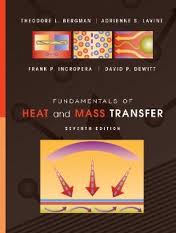
Download : Fundamentals of Heat and Mass Transfer [Hardcover] by Theodore L. Bergman

Fundamentals of Heat and Mass Transfer
The standard for mastering heat and mass transfer
Respected for its readability, comprehensiveness, and relevance, Incropera and DeWitt’s text is the recognized standard for learning heat and mass transfer. This text combines detailed coverage with the resources students need to learn the concepts and apply them to solving realistic and relevant problems.  Using a rigorous and systematic problem-solving methodology, the text is filled with examples and problems that reveal the richness and beauty of the discipline.

The 6th Edition introduces coauthors Ted Bergman and Adrienne Lavine, who bring their record of success in teaching and research in heat and mass transfer to the text.
New Features
  • Expanded coverage of areas of recent interest in heat transfer, including fuel cells and alternative energy devices, electronics cooling, micro-scale heat transfer, and biological as well as bioheat transfer. New examples and homework problems are included for each area.
  • Introduction to the concepts of nano-scale transport and unified treatment of transient conduction.
  • New material on two-phase heat transfer and enhanced internal forced convection.
  • New and revised presentation of mass transfer including applications in materials science and biological engineering.
  • New, revised, and updated problems and examples.


Saturday, April 14, 2012 | 0 comments | Read More
Free Download | Hume-Rothery Rules for Structurally Complex Alloy Phases | Uichiro Mizutani

Written By share_e on Thursday, December 8, 2011 | Thursday, December 08, 2011

With a history that reaches back some 90 years, the Hume-Rothery rules were developed to provide guiding principles in the search for new alloys. Ultimately, the rules bridged metallurgy, crystallography, and physics in a way that led to the emergence of a physics of the solid state in 1930s, although the physical implications of the rules were never fully resolved. Even today, despite a revived interest brought about by the 1984 discovery of quasicrystals, much about the rules remains an enigma. Now almost a century after the rules were put forward, Hume-Rothery Rules for Structurally Complex Alloy Phases provides researchers with an insightful and applicable interpretation of the Hume-Rothery electron concentration rule. Invoking first-principle band calculations, the book emphasizes the stability of structurally complex metallic alloys (CMAs).Written by Uichiro Mizutani, long considered the most knowledgeable expert on both the history and science of Hume-Rothery, this seminal work — Offers a unified interpretation of phase stabilization mechanism of CMAs in different classes Explains how to determine the effective valency of transition metal elements Details establishment of d-states-mediated-FsBz interactions in strongly orbital-hybridizing systems Covers the contrast between e/a and VEC, two notions of electron concentration parameters and includes a way to differentiate between them in designing new alloys Explores strengths and shortcomings for the theory on alloy phase stability Discusses the latest take on electron concentration for gamma-brass This work summarizes the ongoing history of Hume-Rothery and reflects the theoretical studies that Professor Mizutani embarked upon to gain deeper understanding of the basic physics behind stabilizing effects related to electron concentration. It describes how metallic and covalent bonding styles can be harmonized to stabilize a given phase in relation to electron concentration and electrochemical effect as defined by the rules. Beyond theory, the approaches presented in these pages will prove of great value to researchers developing new functional metals and alloys.
Thursday, December 08, 2011 | 0 comments | Read More

Free Download | Polymer Electrolytes: Fundamentals and Applications | Cesar Sequeira, Diogo Santos

Polymer electrolytes are electrolytic materials that are widely used in batteries, fuel cells and other applications such as supercapacitors, photoelectrochemical and electrochromic devices. Polymer Electrolytes: Fundamentals and Applications provides an important review of this class of ionic conductors, their properties and applications. Part one reviews the various types of polymer electrolyte compounds, with chapters on ceramic polymer electrolytes, natural polymer-based polymer electrolytes, composite polymer electrolytes, lithium-doped hybrid polymer electrolytes, hybrid inorganic-organic polymer electrolytes. 

There are also chapters on ways of characterizing and modeling polymer electrolytes. Part two discusses applications such as solar cells, supercapacitors, electrochromic and electrochemical devices, fuel cells and batteries. With its distinguished editors and international team of contributors, Polymer Electrolytes: Fundamentals and Applications will be a standard reference for all those researching and using polymer electrolytes in such areas as battery and fuel cell technology for automotive and other applications. 

Thursday, December 08, 2011 | 0 comments | Read More

Free Download | Polymer modified bitumen: Properties and characterisation | Tony McNally

The addition of polymers to bitumen allows the modification of certain physical properties, such as softening point, brittleness and ductility, of the bitumen. Polymer modified bitumen: Properties and characterisation provides a valuable and in-depth coverage of the science and technology of polymer modified bitumen. After an initial introduction to bitumen and polymer modified bitumen, the book is divided into two parts. Chapters in part one focus on the preparation and properties of a range of polymer modified bitumen, including polymer bitumen emulsions, modification of bitumen with poly (urethanes), waste rubber and plastic and polypropylene fibers. Part two addresses the characterization and properties of polymer modified bitumen. Chapter topics covered include rheology, simulated and actual long term aging studies; the solubility of bituminous binders in fuels and the use of Fourier transform infrared spectroscopy to study aging/oxidation of polymer modified bitumen. Polymer modified bitumen is an essential reference for scientists and engineers, from both academia and the civil engineering and transport industries, interested in the properties and characterization of polymer modified bitumen.

Thursday, December 08, 2011 | 0 comments | Read More

Free Download | Nanostructured metals and alloys - Processing, microstructure, mechanical properties and applications | Sung H. Whang

Written By share_e on Wednesday, December 7, 2011 | Wednesday, December 07, 2011

One of the most important issues facing nanostructured metals and alloys is how to produce them. Part 1 describes the different methods used to process bulk nanostructured metals and alloys, including chapters on severe plastic deformation, mechanical alloying and electrodeposition among others. Part 2 concentrates on the microstructure and properties of nanostructured metals, with chapters studying deformation structures such as twins, microstructure of ferrous alloys by equal channel angular processing, and characteristic structures of nanostructured metals prepared by plastic deformation. 

In part 3, the mechanical properties of nanostructured metals and alloys are discussed, with chapters on such topics as strengthening mechanisms, nanostructured metals based on molecular dynamics computer simulations, and surface deformation. Part 4 focuses on existing and developing applications of nanostructured metals and alloys, covering topics such as nanostructured steel for automotives, steel sheet and nanostructured coatings by spraying.

Wednesday, December 07, 2011 | 0 comments | Read More

Free Download | Metals for Biomedical Devices | M. Niinomi

While medical devices now employ a wide range of composite materials, metallic implants are still in great demand and remains a commercially viable sector of the industry. Given their widespread use in medical devices, it is vital that the fundamentals and behavior of metals are understood. To meet this need, Metals for Biomedical Devices reviews the latest techniques in metal processing methods and the critical aspects of their behavior that might effect both production and application. The text begins with a review of the current status and selection of metals for biomedical devices. 

A second section discusses mechanical behavior, degradation, and testing of metals with specific chapters on corrosion, wear testing, and the biocompatibility of various biomaterials. A third section covers the processing of metals for biomedical applications with chapters on such topics as forging metals and alloys, surface treatment, coatings, and sterilization. Chapters in the final section discuss clinical applications of metals such as cardiovascular and orthopaedic uses and the employment of new generation biomaterials. With its distinguished editor and team of expert contributors, Metals for Biomedical Devices is certain to become a standard reference for materials scientists, researchers, and engineers working in the medical devices industry and academia. 

Wednesday, December 07, 2011 | 0 comments | Read More

Free Download | Hydrometallurgy: Principles and Applications (Woodhead Publishing in Materials) | Thomas Havlik

Hydrometallurgy: Principles and Applications focuses on the theoretical principles and engineering aspects of hydrometallurgical processes. Written in a reader-friendly style, it offers complete coverage of leaching, including in-situ, heap, dump, and vat leaching. 

Subsequent chapters examine solution concentration and purification methods, such as solvent extraction and ion exchange, as well as metal recovery via electrolysis and precipitation. 

Illustrating the practical aspects of hydrometallurgy, the book also analyzes the production of copper as a real-world example of where chalcopyrite leaching is the main process used for extracting copper from sulfide minerals in the industry.

Wednesday, December 07, 2011 | 0 comments | Read More

Free Download | Progress in Zeolite and Microporous Materials (Studies in Surface Science and Catalysis) | H. Chon, S.-K. Ihm, Y.S. Uh

Written By share_e on Sunday, December 4, 2011 | Sunday, December 04, 2011

The proceedings of the 11th Zeolite Conference has been published in three volumes, containing 5 plenary lectures and 274 full papers. Part A comprises Synthesis and Characterization (99 papers), Part B Catalysis and Environment (102 papers) and Part C Adsorption and Diffusion, Modifications, Novel Materials and Theory (78 papers).

Zeolite science and technology has been and continues to be an area receiving great attention. Increasing interest in the synthesis and the characterization of zeolite and microporous materials is reflected in the large number of contributions. Other areas gaining recognition include novel materials, adsorption, theory and modeling.

Sunday, December 04, 2011 | 0 comments | Read More

Free Download | Modern Ferrite Technology | Alex Goldman

Written By share_e on Sunday, November 27, 2011 | Sunday, November 27, 2011

For the past seventy years, ferrites (magnetic ceramics) have been prized for a range of properties that has no equivalent in the existing metal magnetic materials. They have contributed to many important advances in electronics and new high-performance products are appearing all the time. Ferrite technology has produced greater progress in the past 15 years since the first edition was published. Many of the semiconductor and IC technology responsible for the computer and Internet explosion would not have been possible without the magnetic materials technology needed for powering and otherwise exploiting those developments.

Modern Ferrite Technology, 2nd ed, offers the readers an expert overview of the latest ferrite advances as well as their applications in electronic components. This volume develops the interplay among material properties, component specification and device requirements using ferrites. Throughout, emphasis is placed on practical technological concerns as opposed to mathematical and physical aspects of the subject.
The book traces the origin of the magnetic effect in ferrites from the level of the simplest particle and the increases the scope to the larger and larger hierarchies. From the desired magnetic properties the author deduces the physical and chemical material parameters, taking into consideration major chemistry, impurity levels, ceramic microstructures and grain boundary effects. He then discusses the processing conditions and associated conditions required for implementation. In addition to conventional ceramic techniques, he describes non-conventional methods such as coprecipitation, co-spray roasting and single crystal growth.
The second section of this book deals with a complete listing of the many important applications in the field including ferrites for permanent magnet, telecommunications, power supplies, memory systems magnetic recording and microwave applications.

The function of ferrites in each of these applications is described. The requirements of the electronic circuit and device are broken down into the individual component specifications with regard to size and configuration. Design criteria for power level, degree of stability and cost are then considered. 

Sunday, November 27, 2011 | 0 comments | Read More

Free Download | Complex Metallic Alloys: Fundamentals and Applications | Jean-Marie Dubois, Esther Belin-Ferr?, Knut Urban

Covering fundamental research as well as real-world applications, this first book on CMAs at an introductory level treats everything from atomistic details to surface processing. Comprehensive, self-contained chapters provide readers with the latest knowledge on the most salient features of the topic, selected in terms of their relevance to potential technological applications. 

Edited by one of the most distinguished authorities on quasicrystals and this most important of their subclasses, the contributions elucidate aspects of CMAs from a particular viewpoint: physical and chemical characteristics in the sub-nanometer regime, mesoscale phenomena, preparation and processing of thin films, and large-scale engineering properties. The whole is rounded off by a look at the commercial potential of CMA-based applications.For PhD students and lecturers alike.

Sunday, November 27, 2011 | 0 comments | Read More

Free Download | Terpyridine-based Materials: For Catalytic, Optoelectronic and Life Science Applications | Ulrich S. Schubert, Andreas Winter, George R. Newkome

The purposeful self-assembly of discrete molecules or atoms to form larger-scale, systematic structures is termed supramolecular chemistry - a field that earned the 1987 Nobel prize in chemistry for its pioneers Lehn, Pedersen, and Cram. Self-recognition and reproducible self-assembly are one of the great keys to life, with DNA and its information-carrying helix structure being the best example. 

A very promising approach to the creation of man-made materials with superior properties and perfectly defined structures is the imitation and harnessing of natural and unnatural self-assembly processes. This first book to didactically illustrate terpyridine complexes covers topics ranging from their syntheses, chemistry, and properties via supramolecular structures, and multinuclear metal complexes, right up to functionalized polymers, 3D-architectures, and surfaces. Invaluable for students and lecturers in chemistry and biochemistry, materials scientists, as well as polymer, inorganic, and physicochemists.

Sunday, November 27, 2011 | 0 comments | Read More

Free Download | Introduction to Surface Engineering and Functionally Engineered Materials (Wiley-Scrivener) by: Peter Martin

This book provides a clear and understandable text for users and developers of advanced engineered materials, particularly in the area of thin films, and addresses fundamentals of modifying the optical, electrical, photo-electric, triboligical, and corrosion resistance of solid surfaces and adding functionality to solids by engineering their surface, structure, and electronic, magnetic and optical structure. Thin film applications are emphasized. Through the inclusion of multiple clear examples of the technologies, how to use them,and the synthesis processes involved, the reader will gain a deep understanding of the purpose, goals, and methodology of surface engineering and engineered materials.

Virtually every advance in thin film, energy, medical, tribological materials technologies has resulted from surface engineering and engineered materials. Surface engineering involves structures and compositions not found naturally in solids and is used to modify the surface properties of solids and involves application of thin film coatings, surface functionalization and activation, and plasma treatment. Engineered materials are the future of thin film technology. Engineered structures such as superlattices, nanolaminates, nanotubes, nanocomposites, smart materials, photonic bandgap materials, metamaterials, molecularly doped polymers and structured materials all have the capacity to expand and increase the functionality of thin films and coatings used in a variety of applications and provide new applications. New advanced deposition processes and hybrid processes are being used and developed to deposit advanced thin film materials and structures not possible with conventional techniques a decade ago. Properties can now be engineered into thin films that achieve performance not possible a decade ago. 

Sunday, November 27, 2011 | 0 comments | Read More

Free Download | Tribology of Ceramics and Composites: Materials Science Perspective | Bikramjit Basu, Mitjan Kalin

This book helps students and practicing scientists alike understand that a comprehensive knowledge about the friction and wear properties of advanced materials is essential to further design and development of new materials. 

With important introductory chapters on the fundamentals, processing, and applications of tribology, the book then examines in detail the nature and properties of materials, the friction and wear of structural ceramics, bioceramics, biocomposites, and nanoceramics, as well as lightweight composites and the friction and wear of ceramics in a cryogenic environment. 

Sunday, November 27, 2011 | 0 comments | Read More

Free Download | Mechanics and Electrodynamics of Magneto- and Electro-elastic Materials

Written By share_e on Friday, June 24, 2011 | Friday, June 24, 2011

This volume presents a state-of-the-art overview of the continuum theory of both electro- and magneto-sensitive elastomers and polymers, which includes mathematical and computational aspects of the modelling of these materials from the point of view of material properties and, in particular, the "smart-material" control of their mechanical properties.

Constitutive equations deformation gradient dielectric elastic elasticity tensor elastomers electric field Electroactive Polymer electroelastic Lorentz force magnetic field magnetostatics nematic nonlinear.


Friday, June 24, 2011 | 0 comments | Read More

Free Download | Amorphous Chalcogenide Semiconductors and Related Materials

"Amorphous Chalcogenide Semiconductors and Glasses" describes developments in the science and technology of this class of materials. This book offers an up-to-date treatment of chalcogenide glasses and amorphous semiconductors from basic principles to applications while providing the reader with the necessary theoretical background to understanding the material properties technology of this class of materials. This book offers an up-to-date treatment of chalcogenide glasses and amorphous semiconductors from basic principles to applications while providing the reader with the necessary theoretical background to understanding the material properties. 

Chalcogenides form a special class of materials, which have one or more of the elements from the chalcogen group, Group VI in the Periodic Table (S, Se. or Te) as a constituent; the chalcogen is mixed with other elements to form various "new" compounds and alloys. 

Chalcogenides are noncrystalline solids because their structure is "amorphous" or "glassy". Such structures have totally different properties than crystalline solids. Chalcogenide glasses have a number of very interesting and useful properties, which have been already exploited in the commercialization of new devices.

Friday, June 24, 2011 | 0 comments | Read More

Free Download | Dynamic Behavior of Materials, Volume 1 | Tom Proulx

Dynamic Behavior of Materials represents one of eight volumes of technical papers presented at the Society for Experimental Mechanics Annual Conference on Experimental and Applied Mechanics, held at Uncasville, Connecticut, June 13-16, 2011. The full set of proceedings also includes volumes on Mechanics of Biological Systems and Materials, Mechanics of Time-Dependent Materials and Processes in Conventional and Multifunctional Materials, MEMS and Nanotechnology; Optical Measurements, Modeling and, Metrology; Experimental and Applied Mechanics, Thermomechanics and Infra-Red Imaging, and Engineering Applications of Residual Stress.
Friday, June 24, 2011 | 0 comments | Read More

Free Download | Advances in Sustainable Manufacturing

Non-renewable materials can no longer be disposed once humankind's ever increasing needs cannot be fulfilled anymore due to limited resources. Reuse and recycling become inevitable requirements for product and process design. Renewable resources must not be consumed in quantities higher than can be regained. New technologies have to be developed and applied for a Sustainable Product Development and Life Cycle Engineering to fulfill the needs of humankind, protecting public health, welfare, and environment.

The 8th Global Conference on Sustainable Manufacturing brings together some of the world'"s leading experts to present a scientific conference in Abu Dhabi, one of the world'"s fastest growing economies and a global leader in the development of sustainable technologies.The conference will focus on 7 areas:Value adding by sustainable manufacturing in the UAE Potentials of renewables Education for sustainability engineering Green supply chain and transportation Microelectronics and resource efficiency Technology driven startups Sustainable products and manufacturing processes
Friday, June 24, 2011 | 0 comments | Read More

Free Download | Materials Science with Ion Beam

Written By share_e on Wednesday, June 22, 2011 | Wednesday, June 22, 2011


This book introduces materials scientists and designers, physicists and chemists to the properties of materials that can be modified by ion irradiation or implantation. These techniques can help design new materials or to test modified properties; novel applications already show that ion-beam techniques are complementary to others, yielding previously unattainable properties. Also, ion-beam interactions modify materials at the nanoscale, avoiding the often detrimental results of lithographic or chemical techniques. Here, the effects are related to better-known quasi-equilibrium thermodynamics, and the consequences to materials are discussed with concepts that are familiar to materials science. Examples addressed concern semiconductor physics, crystal and nanocluster growth, optics, magnetism, and applications to geology and biology.

Wednesday, June 22, 2011 | 0 comments | Read More

Free Download | Engineering Materials and Processes Desk Reference

Written By share_e on Saturday, June 18, 2011 | Saturday, June 18, 2011


A one-stop Desk Reference, for engineers involved in the use of engineered materials across engineering and electronics; this is a book that will not gather dust on the shelf. It brings together the essential professional reference content from leading international contributors in the field. Material ranges from basic to advanced topics including materials and process selection; and explanations of properties of metals, ceramics, plastics and composites * A hard-working desk reference, providing all the essential material needed by engineers on a day-to-day basis* Fundamentals, key techniques, engineering best practice and rules-of-thumb together in one quick-reference sourcebook* Definitive content by the leading authors in the field, including Michael Ashby, Robert Messler, Rajiv Asthana and R J Crawford

Saturday, June 18, 2011 | 0 comments | Read More